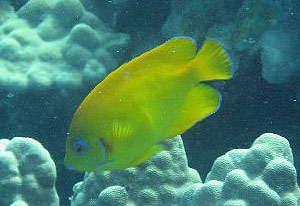
LEMONPEEL ANGELFISH
Centropyge flavissima (Cuvier, 1831)
As far as we know, this common Indo-Pacific angelfish
has never established itself naturally in the Hawaiian Islands. It is
often imported for the aquarium trade, however, and individuals were apparently
released off Oahu in the 1990s in spots such as Keehi Lagoon, Kaneohe
Bay, and the Ala Wai Canal. Rare sightings continue to be made, some from
as far away as the Big Island. It is possible, therefore, that released
Lemonpeel Angels are now reproducing in low numbers in Hawaii. On the
other hand, ichthyologist Henry W. Fowler reported the species as a stray
in Hawaiian waters in 1928, long before the aquarium trade was established;
perhap these rarely-seen angels drift in as larvae from time to time,
sometimes surviving to adulthood. To about 5 in. Photo: Kona, Hawaii,
Robyn Smith.
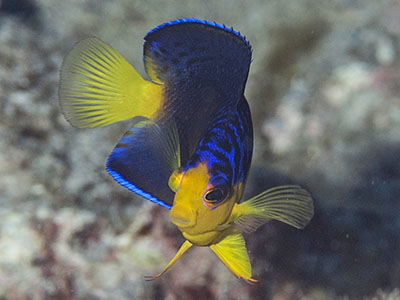
NAHACKY'S
ANGELFISH
Centropyge nahackyi Kosaki, 1989
In 1987, Randall Kosaki discovered this gorgeous fish
at Johnston Atoll, where it lives at depths of 80 ft. or more on gently
sloping outer reef areas devoid of ledges or other vertical relief. It
is dark blue-brown with a bright yellow tail base, abdomen and head. The
top of the head (nape) is marked with iridescent blue bars interspersed
with black. In 1988, fish collector Anthony Nahacky caught a single individual
of the as-yet unnamed species off Honaunau, Hawai`i, at a depth of about
115 ft. He kept it in his aquarium for some time before donating it to
science. Nahacky's find was almost certainly a stray (as was another individual
found at South Point, Hawaii Island, in 2013, shown above). Kosaki named
the fish after Nahackyi in honor of his numerous contributions to our
knowledge of Indo-Pacific fishes. The species is closely related to C.
multicolor (pictured below), an angelfish common in the Marshalls
and other central and south Pacific island groups. Curiously, a stray
C. multicolor was also once captured along the Kona coast of the
Big Island. To about 3 in. Nachakyi's Angelfish is endemic to Johnston
Atoll.
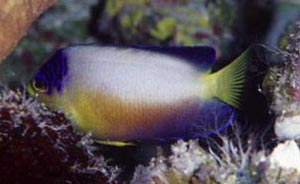
Centropyge multicolor Randall & Wass, 1974
If you see this fish in Hawai`i, or the one above, email me! t has only been recorded from Hawaiian waters once before, off the Kona coast of the Big Island. Nahackyi's Angelfish, a Johnston Island endemic, is similar. It too has been seen off Kona--and only once. The Multicolor Anglefish occurs throughout Micronesia. In the Marshall Islands it typically lives on steep seaward slopes at depths of 80 feet or more. Photo: Majuro Atoll, Marshall Islands. 100 ft.
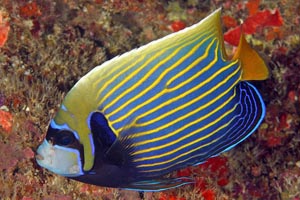
Bill Stohler
EMPEROR ANGELFISH
Pomacanthus imperator (Bloch, 1787)
Stu Ganz and
Bill Stohler both sent me photos of this Emperor Angelfish, seen by each
them individually on May 9, 2010, in a swim-through cave at Sharks Cove,
Pupukea, O`ahu. The species is native to coral reefs from Africa to the
Line Islands and French Polynesia, but not to Hawai`i. Given that it was
seen at one of O`ahu's most popular dive sites, the fish is almost certainly
an aquarium release. There is, of course, the more remote possibility
that it got here naturally. Such things have happened. In 1948, before
the advent of the commercial aquarium trade, an adult was captured in
a trap off Ewa at a depth of 90 ft. But there is no evidence that a breeding
population has ever existed in Hawai`i.
If
this Pupukea fish arrived naturally, it would likely have grown up in
the area where it was photographed. And if a juvenile Emperor Angelfish
(even more spectacular than the adult) had been present last summer, it
would certainly have been noticed and photographed by dozens of divers,
and the word would have certainly got out. Of course, in the unlikely
event that it did grow up here unnoticed, it is questionable whether such
a fish could survived the onslaught of this winter's waves.
As a matter
of interest, another Emperor Angelfish lived for some years in Honolulu
Harbor, near the Falls of Clyde and could easily be seen from shore.
Other species
from outside Hawai‘i, such as the
Lemonpeel Angelfish (Centropyge flavissimus), Semicircle Angelfish
(Pomacanthus semicirculatus), and Regal Angelfish (Pygoplites
diacanthus), are occasionally released by irresponsible aquarists
or fish importers, but are not known to be reproducing in Hawaiian waters.
UPDATE from Dave Lum,
June 2014
I was browsing through
some websites on marine life this evening and came across the page on
your site that described an Emperor Angelfish living in a swim-through
at Shark’s Cove (Pupukea). I believe that I saw this exact same fish
this year (21 June 2014), while I was exploring a long lava tube at a
depth of about 40ft just to the north of the mouth of Shark’s Cove.
The fish was about 8” in length without a streamer on its dorsal
fin. It was surprisingly tame and followed me through most of my tour
of the tube, which was quite dark and occupied by many nocturnal species.
After exiting the lava tube on the other side of the structure, I swam
back to the entrance where again I was met by the imperator. According
to your site, it was last reported in 2010, so it’s somehow managed
to survive in this habitat for since the last report.