|
hawaiisfishes.com
|
|
Home |
Fishes | Invertebrates |
Books | CDs
| Links |
Contact |
|
Some interesting
sea stars not in Hawaii's
Sea Creatures |
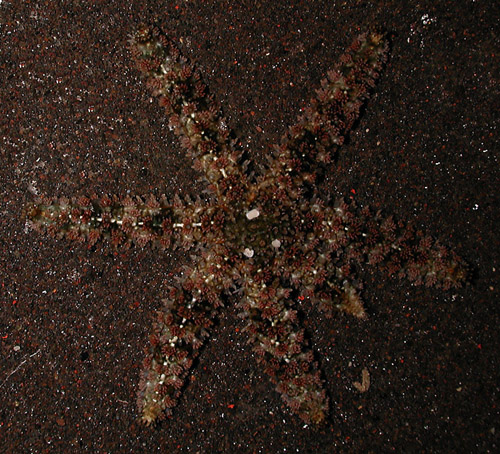 upper side - photo: Cory Pittman |
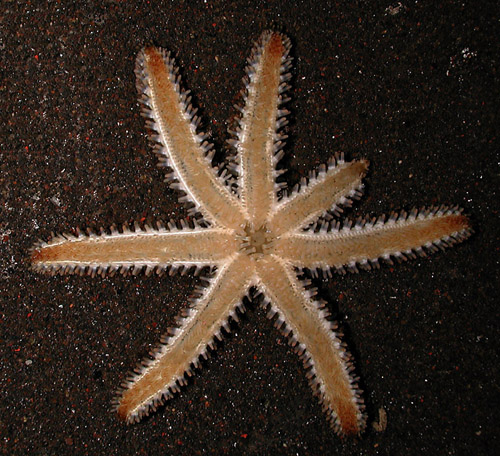 underside - photo: Cory Pittman |
|
Coscinasterias
acutispina (Stimpson, 1862) |
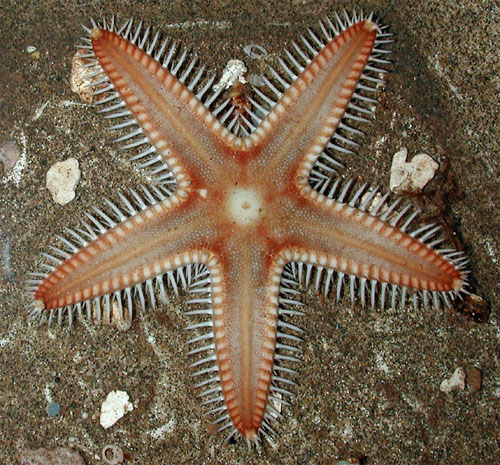 photo: Cory Pittman |
|
Astropecten
polyacanthus
Muller and Troschel, 1842 |
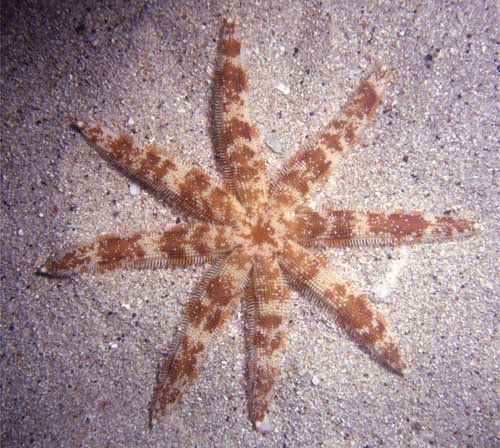 |
|
Luidia aspera
Sladen, 1889 |
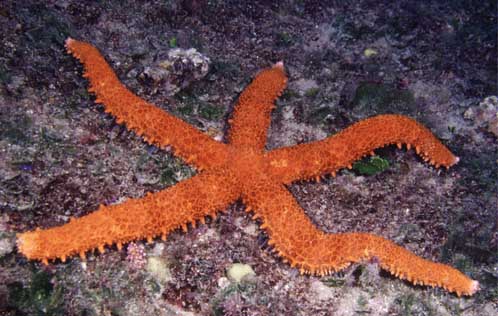 |
| Mithrodia
fisheri? Holly, 1932 family Mithrodiidae In my book I have a photo of a much smaller specimen of Mithrodia fisheri and state that the species is most active at night and usually found in caves. I also state that individuals are typically 4-6 in. across, but note that Edmonsdon records specimens up to 20 in. across. When I wrote the book I had never seen a large Mithrodia in Hawai`i and was a bit skeptical of Edmondson's record. Well, I was wrong. Off Makua, O`ahu, at about 80 ft., I've seen large specimens at least 12 in. across, and possibly larger. I also saw one once off Barge Harbor, Lana`i. Unlike their smaller brethren, these big guys are out and about in the middle of the day. It's possible that two separate species are involved, but it seems equally likely that smaller ones in shallow water tend to be nocturnal while larger ones in deeper, dimmer water don't mind coming out by day. Just for the record, below is a photo of a tiny juvenile taken in shallow water off Kahe Point, O`ahu. It was under a coral slab. I added this photo to the Revised Edition of Hawaii's Sea Creatures. |
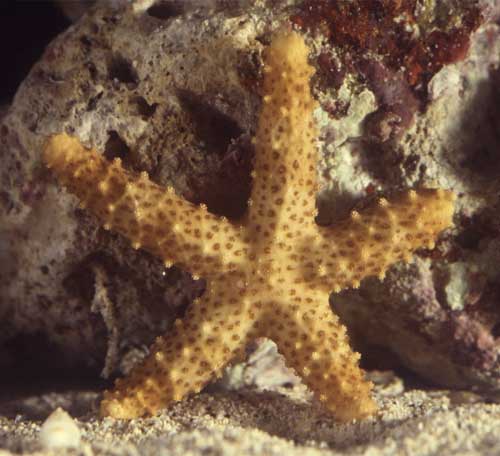 Mithrodia fisheri juvenile |
|
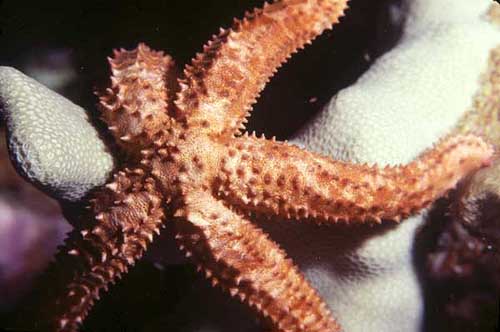
I saw this star on a night dive in Hanauma Bay, O`ahu, in the Finger Coral beds at about 50 ft. I couldn't photograph it where it was under the coral, so I placed it on the coral for a clearer view. I have never seen another. After quite a bit of work, Chris Mah identified it from the photo as Sclerasterias euplecta. I know nothing more about the animal. Perhaps its center of population lies deeper than most scuba divers care to go. I have added this photo to the revised edition of Hawaii's Sea Creatures. |